Category: Food

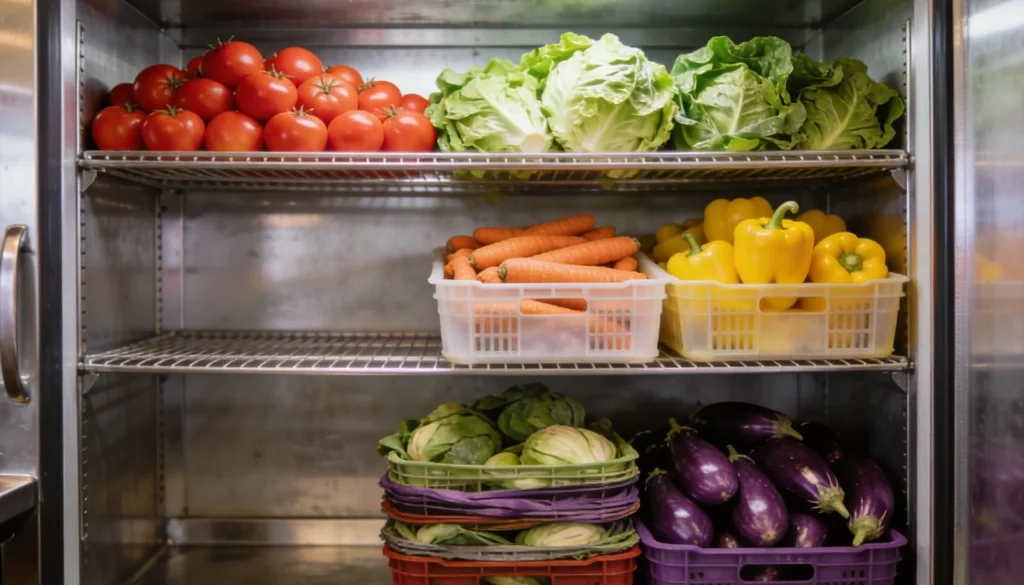
Organized restaurant produce cooler with fresh vegetables for produce inventory management
Food

Produce Inventory Management: How to Reduce Spoilage and Improve Control

Struggling with produce spoilage and inconsistent ordering? Strong produce inventory management can help you reduce waste, improve visibility, and make smarter purchasing decisions.

If you’ve ever opened a cooler and found produce that didn’t make it to the plate, you already know the problem. 

Spoilage isn’t just frustrating. It eats into margins, creates unnecessary reordering, and makes it harder to stay consistent with your menu. 

That’s where produce inventory management comes into play. Not as some big system overhaul, but as a set of smarter habits that help you keep tighter control over what’s coming in, what’s being used, and what’s going to waste. 

Why Produce Spoilage Is a Common Challenge in Foodservice 

Produce moves fast. It also turns fast. And most operations are juggling a lot more than just what’s sitting in the walk-in. 

Short Shelf Life 

Unlike shelf-stable items, fresh produce doesn’t give you much room for error. A few extra days in the cooler can mean the difference between usable and unusable. 

Limited Inventory Visibility 

A lot of teams don’t have a clear picture of what’s actually on hand. Items get tucked behind others, partial cases go unnoticed, and suddenly you’re ordering something you already have. 

Operational Delays 

Prep gets pushed. Deliveries come in during a rush. Items don’t get put away properly. Small delays add up and shorten usable shelf life. 

Demand Variability 

Covers fluctuate. Weather shifts traffic. Promotions hit harder than expected. It’s tough to predict exactly how much produce you’ll need. 

Over-Ordering Practices 

When there’s uncertainty, the instinct is to order a little extra “just in case.” That cushion often turns into waste. 

Where Inventory Management Breaks Down 

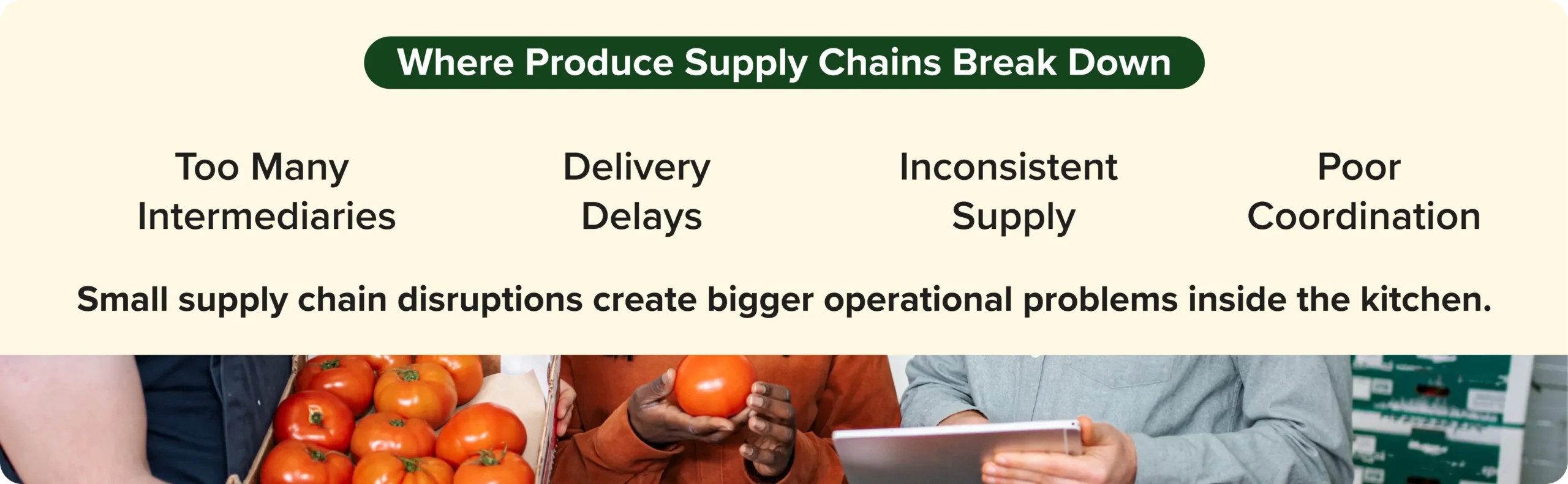
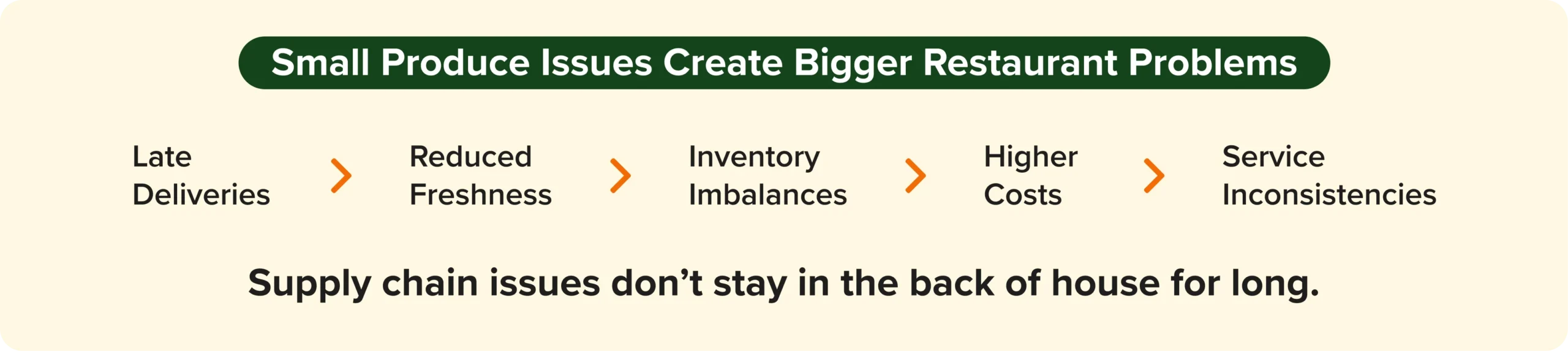
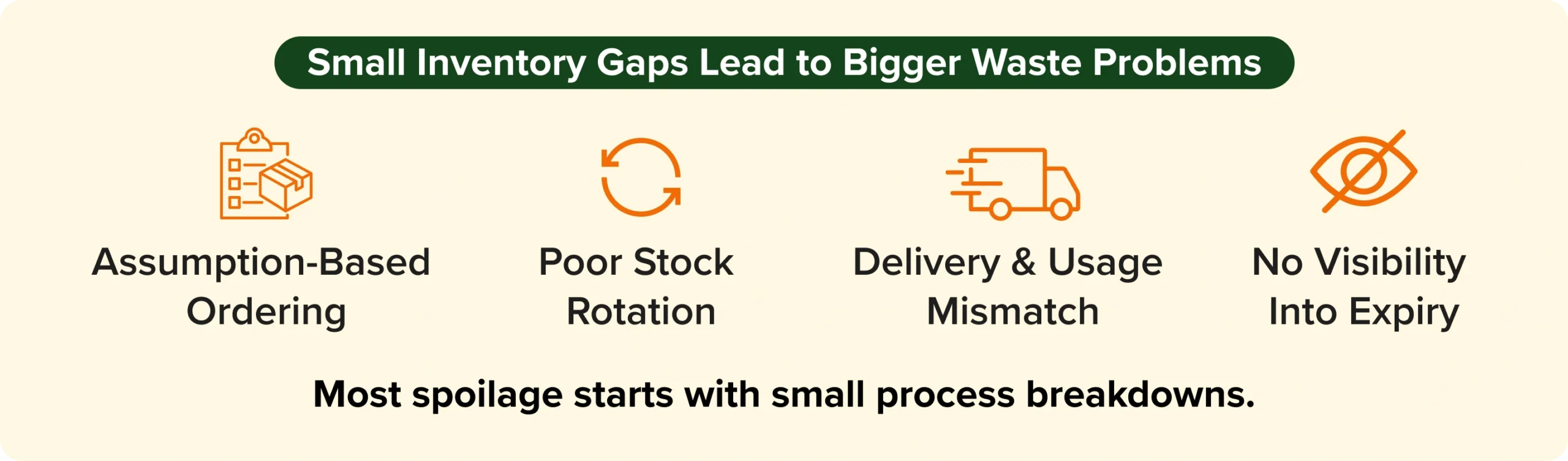
Most spoilage issues aren’t caused by one big mistake. They come from small gaps in the day-to-day process. 

Produce inventory management process gaps that lead to food spoilage in restaurants

Assumption-Based Ordering 

Orders are often based on habit instead of actual usage. “We usually go through this much” doesn’t always hold up week to week. 

Poor Stock Rotation 

If newer product gets used before older product, it’s only a matter of time before something gets left behind. 

Delivery and Usage Mismatch 

Getting a big shipment right before a slow time can mean that the product sits around longer than it should. 

No Visibility into Expiry 

Without clear labeling or tracking, it’s easy to lose track of what needs to be used first. 

How to Improve Internal Inventory Processes to Reduce Waste 

This is where produce inventory management starts to pay off. Small process changes can make a noticeable difference. 

Consumption-Based Ordering 

Instead of guessing, look at what you’re actually using. Even a simple weekly review of usage patterns can help tighten ordering. 

It also helps to regularly review par levels instead of relying on the same numbers month after month. Usage can shift quickly based on seasonality, menu changes, promotions, or customer traffic, and outdated pars often lead to over-ordering without anyone realizing it. 

Frequent, Mmaller Deliveries 

More frequent deliveries mean less product sitting in storage. It keeps inventory fresher and easier to manage. 

Most restaurants are realistically only getting deliveries two or three times a week, but even adjusting order sizes around those schedules can make a difference. Smaller, more intentional orders help reduce overcrowded coolers and lower the risk of product sitting too long before it gets used. 

Standardized Storage and FIFO 

First in, first out sounds simple, but it only works if everyone follows the same system. Clear labeling and consistent placement go a long way.

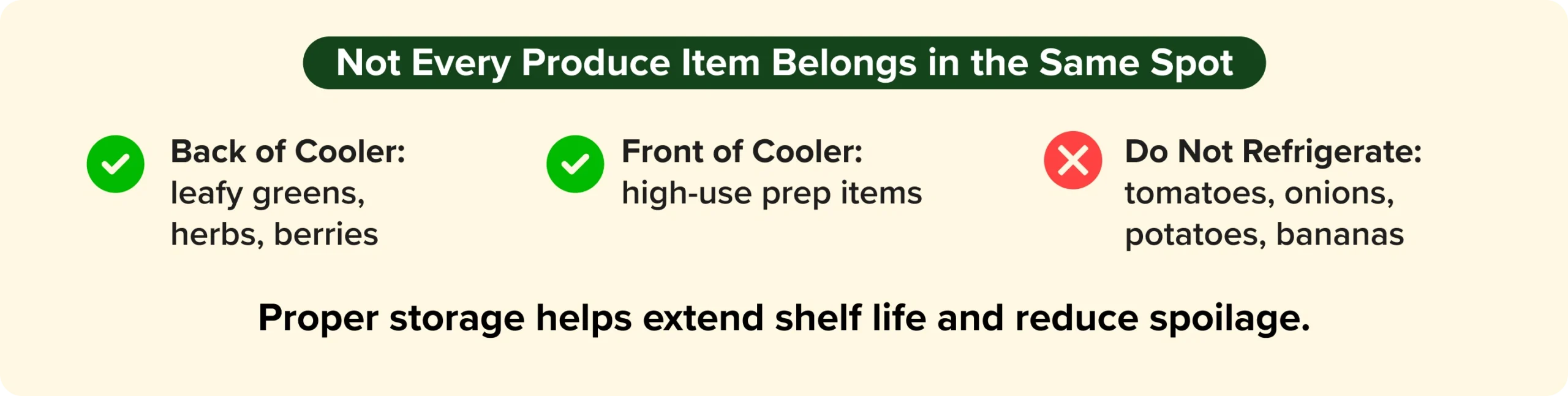
Proper produce storage organization in restaurant cooler inventory management

It also helps to store produce in the right part of the cooler. Some items hold better in colder areas toward the back of the walk-in, while others should stay closer to the front where temperatures are slightly more stable during service. And not every item belongs in the cooler at all. Products like tomatoes, onions, potatoes, and bananas can actually break down faster when they’re refrigerated improperly. 

When teams know where items belong and follow the same setup every time, it becomes a lot easier to reduce spoilage and keep product moving correctly. 

Inventory Movement Tracking 

You don’t need a complex system to start. Even basic tracking of what’s coming in and going out can highlight patterns and problem areas. 

Lack of Inventory Audits 

Regular checks help find problems early. It’s easier to change things when you see things that are moving slowly before they turn into trash. 

Why Real-Time Inventory Visibility Matters in Produce Management 

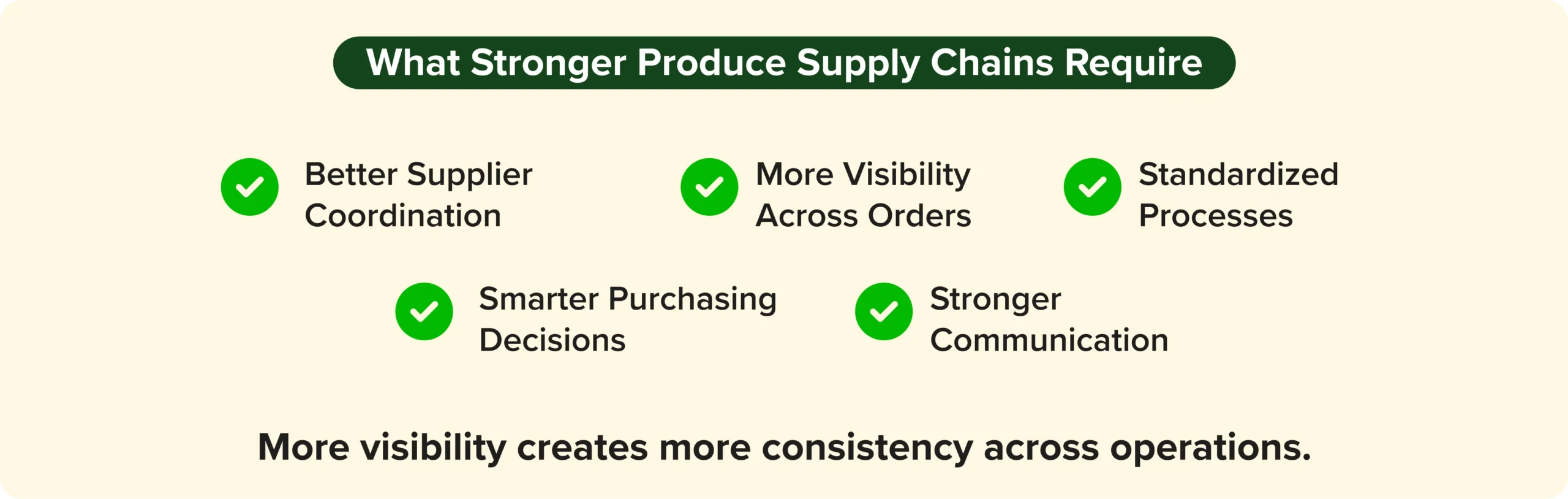
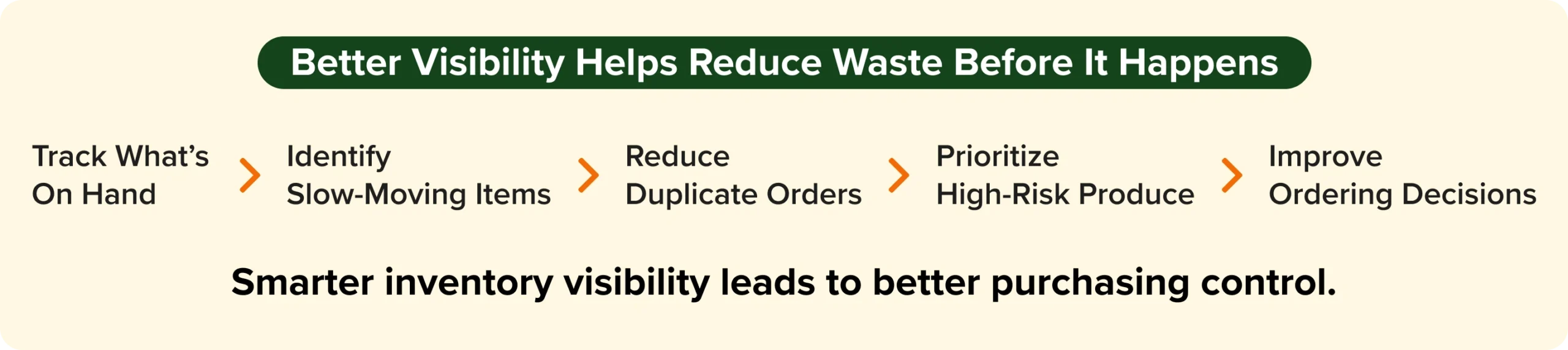
The more visibility you have, the fewer surprises you run into. 

Produce inventory management visibility workflow for reducing restaurant food waste

Real-Time Inventory Tracking 

Knowing what’s on hand at any given time helps prevent duplicate orders and missed product. 

Prioritizing High-Risk Items 

Some items turn faster than others. Keeping an eye on those high-risk products helps reduce spoilage. 

Reducing Reactive Ordering 

When you’re not scrambling to figure out what you have, ordering becomes more intentional and less reactive. 

Improving Multi-Location Decisions 

For multi-unit operators, visibility across locations helps balance inventory and avoid unnecessary overstocking. 

Identifying Slow-Moving Inventory 

If something isn’t moving, you can adjust before it becomes a loss. 

How Inventory Management Impacts Procurement Performance 

Strong produce inventory management doesn’t just affect the kitchen. It directly impacts how you buy. 

Smarter Purchasing Decisions 

When you actually know what’s sitting in your cooler, ordering gets a lot more straightforward. You’re not guessing, you’re not doubling up on items you forgot you had, and you’re definitely not placing last-minute orders to cover a miss. 

Better Demand and Supply Alignment 

Things run a lot smoother when what you’re bringing in matches what you’re actually using. Instead of product piling up or running short mid-week, your inventory starts to move at the pace your kitchen does. 

Better Supplier Planning 

When your ordering is consistent, it’s a lot easier for your suppliers to keep up with you. They know what to expect, you know what you’re getting, and you’re not constantly adjusting on both sides. 

Improved Cost Predictability 

When you’re not throwing product away or scrambling to cover gaps, your costs start to level out. You get a clearer picture of what you’re actually spending instead of chasing it week to week. 

How Structured Produce Programs Improve Inventory Control 

This is usually the turning point for a lot of operators. 

At some point, tightening up internal processes only gets you so far. The next layer is making sure what’s coming into your operation is just as consistent as what’s happening inside it. 

Consistent Product Quality 

Not all produce shows up the same. When quality is all over the place, it throws everything off. You might have product that looks fine on delivery but breaks down faster than expected, which shortens your usable window and creates waste you didn’t plan for. 

Weather also plays a role in produce quality more than a lot of operators realize. Heat waves, heavy rain, freezes, and growing region disruptions can all impact how certain items hold up at different times of the year. Paying attention to seasonal quality shifts and knowing which products may be more vulnerable helps teams plan ahead and adjust expectations when needed. 

When quality is consistent, your team isn’t constantly adjusting or second-guessing how long something will hold. 

Reliable Delivery Schedules 

Timing matters more than people think. 

If deliveries show up late, early, or stacked too close together, it can lead to overcrowded storage or product sitting longer than it should. When deliveries hit on a predictable schedule, it’s easier to plan prep, storage, and usage without things backing up in the cooler. 

Better Supplier Coordination 

A lot of inventory issues start before the product even arrives. 

When there’s clear communication with suppliers, it’s easier to adjust orders, flag issues early, and avoid surprises. That coordination becomes especially important when demand shifts or certain items are harder to source. 

Reduced Pricing Fluctuations 

When pricing is constantly moving, ordering decisions start to feel reactive. 

More stable pricing doesn’t just help with budgeting. It also allows you to order based on what you actually need instead of trying to time the market or overbuy to “lock in” a cost. 

Standardized Ordering Processes 

If every manager orders a little differently, inventory is going to reflect that. 

Having a more consistent approach to ordering helps reduce overlap, missed items, and unnecessary volume. It also makes it easier to spot when something is off. 

Centralized Procurement 

For multi-unit operations, this is where things really start to tighten up. 

Instead of every location handling purchasing completely differently, having more alignment across ordering processes can help create better consistency across the operation. That can lead to more balanced inventory levels, fewer surprises, and better overall visibility into what locations are actually using. 

Data-Driven Insights 

At the end of the day, visibility changes how decisions get made. 

When you can actually see patterns like what’s moving, what’s slowing down, and where waste is happening, it’s a lot easier to adjust before it becomes a bigger issue. 

Conclusion 

Spoilage isn’t always avoidable, but a lot of it is preventable. 

With better produce inventory management, operators can reduce waste, improve consistency, and make more confident purchasing decisions. It’s not about adding more complexity. It’s about tightening the process so everything works a little more smoothly. 

Want better control over produce waste, ordering, and inventory visibility? Click here to contact Fresh Concepts to learn how smarter produce inventory management can help improve consistency and reduce spoilage.

FAQs 

What is produce inventory management in foodservice? 

It’s really just how you keep track of your produce from the moment it comes in the door to the moment it gets used. That includes how you store it, how you rotate it, and how you decide what to order next so nothing gets wasted. 

What causes produce spoilage in restaurants? 

Most of the time, it’s not one big issue. It’s things like ordering a little too much, not rotating product properly, or simply losing track of what’s already in the cooler. Even small gaps like that can lead to waste pretty quickly. 

How often should inventory be checked? 

For items that move fast, it helps to keep an eye on them daily, even if it’s just a quick check. A more complete inventory review once a week usually keeps things from getting out of hand. 

How can inventory management reduce food costs? 

When you’re using what you buy and not throwing it away, your food cost naturally comes down. It also cuts down on those last-minute orders that tend to be more expensive. 

How does inventory impact procurement decisions? 

What you have on hand should drive what you order next. When your inventory is accurate, you’re making decisions based on what’s actually happening in your operation, not just what you think you need.

Feature-Imageseptember2-1024×585
Food

Produce Trends Happening This Year and In the Future

Every year, new and up-and-coming ingredients make their way onto restaurant menus, such as fruits and vegetables. We’ve seen it with brussels sprouts, kale, cauliflower and more.  

But how do these trends come to be? 

For produce specifically, innovative chefs continue to incorporate under-utilized fruits and vegetables in their dishes and look for new, creative ways to highlight them through non-traditional preparations. When an application is particularly successful, restaurants and guests can spread the word on the innovative creations with help from useful tools like social media. 

Keep reading to learn what the produce trends this year and beyond are gearing up to look like. 

Fruit and Vegetable Trends to Watch

Cauliflower, kale, and brussels sprouts are expected to remain popular. We might even see potatoes show some increased interest coming out of the pandemic as chefs look at new ways to top off what is considered a healthy vegetable (that is, unless they’re topped with butter, sour cream, cheese, and bacon. I mean, who doesn’t like a loaded potato? I sure do!) 

Still, there are so many varieties and so many other plant-forward options you can pair with potatoes.  

It’s also suspected that we will continue to see other international fruits and vegetables come into the country due to increasing flavor and menu diversity in the usual large markets. Local produce will continue to grow in popularity, as it remains a popular buzzword. 

Produce Trends and SKU Optimization

The biggest trend we are seeing happen in Produce is not item specific – but buying specific. It’s called SKU optimization.  

More than ever, foodservice operators are under immense pressure to keep food costs down and buy as efficiently as possible. As a result, their buying direction is to purchase full cases wherever possible instead of splits, and to buy whole product instead of pre-cut for critical menu items, to help with shelf life and flavor. Not only are the full case quantities more cost-effective per pound, but the consolidation of SKUs would be beneficial for distribution to help eliminate labor, carbon footprint in packaging, yield loss, and traceability concerns. 

Effective SKU management and optimization can easily result in 10%+ savings on key commodities.  

Unfortunately, identifying where the SKU Optimization opportunities are within your buying can be challenge itself, let alone difficult to manage and implement across all locations due to availability.  

 Fresh Concepts Helps You Stay Ahead of Produce Trends

At Fresh Concepts, we are uniquely capable of managing all SKUs and finding the most impactful opportunities to optimize your buying. We also help you stay up to date on commodity insights and trends.  

Our team of produce experts can help you with all your produce management needs. From menu development to produce specification selection, we are here to keep you informed on the latest produce trends, find you the best savings, and provide you with the support you need to manage your produce process. 

Contact us today to get started!  

https://www.youtube.com/watch?v=HNiBHei-fd8  

Feature-Image
Food

Foodservice Produce Sourcing: How and Why, It Matters

Foodservice produce sourcing refers to the process of acquiring fresh fruits and vegetables for use in restaurants, cafes, hotels, and other foodservice establishments.

Why High-Quality Produce Sourcing Is Important

Sourcing high-quality produce is critical to the success of any foodservice business, as it impacts the taste, quality, and presentation of the dishes served. Using fresh, high-quality produce can help elevate the flavors and overall dining experience for customer too.

On the other hand, using subpar or spoiled produce can lead to a disappointing meal and potentially harm the reputation of your restaurant or foodservice establishment.

How Produce Program Supports Sourcing

This is why it’s important to join a produce program like Fresh Concepts.

At Fresh Concepts, we specialize in produce sourcing specifically for the foodservice industry. We work with a network of growers, packers, and distributors to provide high-quality fresh produce to our clients.

Safe and Reliable Produce Sourcing

Additionally, sourcing produce from reliable and trustworthy suppliers can help ensure that the food is safe to eat. Contaminated or improperly stored produce can lead to foodborne illnesses, which can be incredibly dangerous for customers and damaging for the reputation of the restaurant.

By working with reputable suppliers, foodservice establishments like yours can help reduce the risk of foodborne illness and promote the safety and well-being of their customers.

Sustainable and Local Produce Sourcing

Thankfully, our sourcing process involves a rigorous selection process that focuses on quality, safety, and sustainability.

Furthermore, sourcing produce from local or sustainable sources can help foodservice establishments reduce their environmental impact and support the local economy. By reducing the distance that produce must travel to reach the restaurant, foodservice establishments can help reduce carbon emissions and promote a more sustainable food system.

Additionally, sourcing from local farms and suppliers can help support small businesses and promote economic development in the surrounding community.

Our produce program also offers value-added services such as product education and training, menu planning, and customized solutions to help clients optimize their produce sourcing and improve their bottom line.

Final Thoughts

In conclusion, foodservice produce sourcing is a critical part of running a successful foodservice establishment.

By partnering with a produce program such as Fresh Concepts, establishments can ensure that they source high-quality produce at a reasonable price, which can enhance the taste and improve the safety of the dishes served and contribute to the overall success of their business.

Feature-Image (1)
Food

What Does Field to Table Produce Management Mean?

As a foodservice operator, you may be familiar the term “Field to Table Produce Management.” It’s a term used by many Produce Management companies to bring you the utmost fresh, safe, and reasonably priced produce to your operation.

In more depth, Field to Table Produce Management is a holistic approach to sourcing, focused on pricing, quality, food safety and service throughout the supply chain. Each step in the supply chain is uniquely important and plays a crucial role in protecting quality, price, and food safety.

If there are failures or mismanagement in growing, transportation, cooling, packing, processing, distribution and even handling inside the restaurant, the entire supply chain fails. Like any Team, the final result is only as strong as the weakest link. By qualifying and cultivating relationships with each key stakeholder in the supply chain, an operator can have a deeper and more rewarding experience with each supplier, which will produce higher yields, better products, and lower costs.

Field to Table Produce Management is a form of food traceability, which is, the ability to follow the movement of a food product and its ingredients through all steps in the supply chain, both backward and forward. This documents and links the production, processing and distribution of said products, according to the FDA.

When you are transparent to your customers about where your produce comes from, it shows that you prioritize where and how your food is grown and where it is sourced from – which is locally. You’re giving your guests that reassurance their produce is carefully handled, thoroughly washed, and safely prepared for them to enjoy without hesitation.

Field to Table Produce Management puts your mind at ease because you know you’re getting quality produce that is carefully managed, while paying the correct price. You’re also partnering with a company who demonstrates safety and loyalty to their foodservice operators.

Join Fresh Concepts today to help improve your Field to Table Produce Management and ensure risk management and traceability are always a top priority for your operation.


portfolio-img-1
Food

What is Food Traceability and Why It’s Important

Where did the produce on your plate actually come from? Who handled it before it reached your kitchen? How long was it in transit? If there’s a recall tomorrow, would your team know whether your locations were affected?

Those questions have become a much bigger deal in foodservice over the last few years, especially as operators face growing pressure around food safety, sourcing transparency, and consumer trust.

That’s where food traceability becomes incredibly important for foodservice operators.

What Is Food Traceability?

The FDA describes food traceability as the ability to follow food as it moves through the supply chain. In real life, that means operators can look back and figure out where a product came from, where it went, and who touched it before it reached the kitchen.

That may sound simple, but when you’re dealing with produce moving across multiple suppliers, distributors, trucks, and locations, things can get messy pretty quickly.

A good food traceability process helps operators keep track of things like:

  • Which farm or supplier the product came from
  • Which distributor delivered it
  • When shipments arrived
  • Which locations received certain products
  • Whether any recalled items made it into the building

For operators, this becomes especially important during recalls or food safety situations. Nobody wants to spend hours digging through invoices and delivery records trying to figure out whether affected product was sitting in their cooler the whole time.

How Food Traceability Protects Your Operation

Food traceability plays a major role in protecting both consumers and foodservice operators.

If there’s a food recall or outbreak tied to a produce item, operators need to know immediately whether impacted product made its way into their locations. Delays can create serious risks, both from a food safety standpoint and from a brand reputation standpoint.

Operators should have access to a recall or outbreak communication process that quickly identifies affected products and locations. Waiting too long to respond can increase the chances of unsafe products being served to customers.

Food traceability also helps operators better document supplier activity, product movement, and sourcing information throughout the supply chain. That level of organization becomes extremely valuable during audits, investigations, or food safety reviews.

Why Food Traceability Matters to Consumers

Customers notice this stuff more than operators sometimes realize. People want to know where their food came from, especially when it comes to produce, sourcing, and food safety.

It’s pretty common now for guests to ask questions about ingredients, where products were grown, or whether something was locally sourced. A lot of operators are talking more openly about their suppliers and sourcing practices because customers are paying attention to it.

When operators have better traceability in place, it’s a lot easier to answer those questions without digging through paperwork or trying to track someone down for answers.

Risks of Not Having a Food Traceability Program

Without a strong food traceability program in place, operators may struggle to respond quickly when issues arise.

That can lead to major operational problems, including:

  • Foodborne illness concerns
  • Product recalls
  • Fines or compliance issues
  • Product waste from broad inventory disposal
  • Disruptions across multiple locations
  • Damage to brand reputation

In many cases, operators without clear traceability systems end up throwing away large amounts of inventory simply because they cannot confirm whether specific products were affected.

A well-managed food safety and traceability program helps reduce uncertainty while improving response times and operational confidence.

How Can Fresh Concepts Help Manage Food Traceability?

Food recalls move fast. And when they happen, operators usually don’t have hours to sit around figuring out whether impacted product made it into one location or twenty.

That’s one of the biggest reasons many operators look for stronger traceability support in the first place.

At Fresh Concepts, food safety and traceability are built directly into our managed produce program. If there’s a recall or outbreak, our team can quickly identify whether affected product reached any of your locations across the country.

Instead of sorting through stacks of invoices or trying to piece together delivery records manually, operators have a clearer picture of what products went where and when they arrived.

Our team also works closely with operators on things like:

  • Recall communication and response support
  • Distributor oversight
  • Food safety processes
  • Produce quality management
  • Supply chain visibility
  • Product tracking across locations

Technology is also changing the way food traceability works across the industry. More companies are exploring tools like blockchain tracking and sensor technology to create stronger visibility throughout the supply chain and improve record keeping along the way.

At the end of the day, operators want confidence. They want to know the products entering their kitchens are being monitored carefully and that they have support when issues happen.

That’s exactly what Fresh Concepts helps provide.

Ready to improve food traceability and strengthen your produce program?

Click Here to Connect with the Fresh Concepts Team and learn how our managed produce program can help support your operation with food safety, recall management, and produce expertise.


Feature-Image-1024×536-1024×585
Food

Why Should You Join A Managed Produce Program?

Managing produce purchasing is one of the most challenging parts of running a foodservice operation. Prices fluctuate, product quality can vary from shipment to shipment, and supply chain disruptions can quickly impact your menu and margins. That’s why many operators are turning to a trusted Produce Program to gain more control, consistency, and support across their operations.

Managed produce programs offer a wide variety of benefits to foodservice operators. From cost control to quality control, a Managed Produce Program gives operators access to produce specialists providing immediate support to resolve issues that arise and help you every step of the way.

What is a Produce Program?

A Produce Program is basically a more organized way to manage produce purchasing across your operation.

Instead of spending time chasing down pricing issues, dealing with inconsistent product quality, or trying to sort through distributor problems location by location, operators work with a team that helps oversee the process.

That can include things like pricing support, contract management, food safety oversight, reporting, and help with distributor communication when issues come up.

For operators managing multiple locations, it also helps create more consistency. Everyone is working from the same standards, the same purchasing process, and the same visibility into what’s being ordered and what’s being spent.

Why You Should Join a Managed Produce Program

So why should you join a managed produce program? Let’s look at some of the benefits a Managed Produce Program can offer operators and expert solutions available to help make better business decisions.

Controlled Pricing

Does the cost of your produce orders seem to increase during certain times of the year? From a pricing and cost control perspective, a Managed Produce Program can provide protection against market volatility and consistency in your produce purchasing. Having an expert procurement team negotiating on your behalf with distributors on freight ensures that freight prices listed in the contracts you have in place are what they should be.

Produce markets can shift quickly due to weather events, labor shortages, transportation issues, and seasonal availability. Without a strong Produce Program in place, operators are often left reacting to price increases instead of proactively managing them.

By taking advantage of features such as contract and freight management, a Managed Produce Program can provide an operator with complete transparency into what they’re paying on every contract item at any moment. Operators can know the contract details of every program driving pricing, including shippers, FOB pricing, escalation policies, and contract start and end dates.

This level of visibility helps operators make smarter purchasing decisions while protecting margins across multiple locations.

Technology and Real-Time Visibility

Does the cost of your produce orders seem to increase during certain times of the year? From a pricing and cost control perspective, a Managed Produce Program can provide protection against market volatility and consistency in your produce purchasing. Having an expert procurement team negotiating on your behalf with distributors on freight ensures that freight prices listed in the contracts you have in place are what they should be.

Produce markets can shift quickly due to weather events, labor shortages, transportation issues, and seasonal availability. Without a strong Produce Program in place, operators are often left reacting to price increases instead of proactively managing them.

By taking advantage of features such as contract and freight management, a Managed Produce Program can provide an operator with complete transparency into what they’re paying on every contract item at any moment. Operators can know the contract details of every program driving pricing, including shippers, FOB pricing, escalation policies, and contract start and end dates.

This level of visibility helps operators make smarter purchasing decisions while protecting margins across multiple locations.

Expert Support

By taking advantage of a Managed Produce Program, you get access to a team of produce experts who can help every step of the way. These Produce Support Specialists can assist with conducting regular business reviews with each Produce Distributor in every market servicing your locations, visiting warehouses, reviewing product quality, and evaluating service performance to help ensure your locations receive the products they need.

Having access to experts who visit individual locations also helps ensure best practices are being applied with produce storage and handling. Small operational issues can significantly impact shelf life, freshness, and waste levels, especially across multiple locations.

With a Produce Program, operators gain an additional layer of support focused specifically on produce quality, consistency, and operational efficiency.


The Produce Program Your Operation Needs

Joining an expertly managed Produce Program can help your operation improve quality, safety, and traceability throughout the supply chain while helping lock in pricing and reduce unnecessary costs.

At Fresh Concepts, our Managed Produce Program is a best-in-class, fully comprehensive Produce Program designed to support foodservice operators with the tools, expertise, and visibility they need to operate more efficiently.

Our program includes several key benefits that foodservice operators value, including our Food Safety Program, which offers complete protection to clients in the event of an outbreak or recall. We also maintain thorough documentation of distributor and shipper audits, including second-party audits, all accessible to clients directly through our proprietary Back Office platform.

Fresh Concepts offers all these benefits without any out-of-pocket expenses. Operators gain access to more than 40 produce experts dedicated to helping reduce costs, improve quality, integrate technology tools, and provide hands-on support across every stage of produce procurement.

If your operation is looking for a smarter way to manage produce purchasing, quality, and visibility, a professionally managed Produce Program may be exactly what your team needs.

tomatoesfeatureimage2-1024×585
Food

Having Access to Up-To-Date Commodity Insights Can Impact an Operators Bottom Line

Food prices continue to rise as supply and demand challenges persist throughout the supply chain.

These days, food costs are one of a restaurants’ biggest concerns. Operators are scrambling to pivot to profits and are challenged with offsetting high food costs without effecting the quality of their menu.

Let’s look at how having access to up-to-date commodity insights can improve your purchasing and your bottom line.

Menu Promotions Can Be Impacted

Foodservice operators often schedule promotions months in advance to prepare for the marketing and training component as part of a produce promotion or new menu rollout. Those plans are often made before the vegetables or fruit that are needed for the promotion are even planted.

Weather conditions also play a huge role in the planning of a new promotion. For example, the fruit on a tree may suffer a devastating freeze between the time of the initial planning and the new menu rollout.

The last thing a restaurant wants to do is put up a sign saying, “Out of Stock.” Up-to-date commodity insights can help operators prepare for and potentially even modify a promotion due to changing market and weather conditions that could unintentionally have a financial hit.

Fresh Concepts Can Help

In the world of produce, knowledge is power. Having up-to-date commodity insights can be highly beneficial to cost savings and can help avoid possible shortages.

When Food Service Operators have up-to-date, relevant updates for the commodities they’re buying, they have the ability to pivot their buying to account for changes in the Market.

Let’s take tomato purchases for example. Often, there are times when the Tomato Market might experience a shortage on Rounds, but not on Romas. If a foodservice operator has been purchasing Round Tomatoes but receives a commodity update about Round Markets being escalated, they may be able to update their buying from a Round to a Roma. Having the ability to make quick changes like this can potentially save an operator money. Not only can they save on the actual case cost of the product, but this information can help prevent things such as product shortages, second deliveries, and quality issues – all of which could very well affect the bottom line.

This same method applies to other shortages as well. For example, it can be used for specific sizes for purchases of products such as Citrus or Avocados. The Food Service Operator can switch over to a smaller or medium size SKU if larger sizes are running tight. This then saves them money and increases efficiencies.

If your operation is interested in learning more about transparency into commodity information and price trends, look no further. From Controlled Pricing to Real-Time Visibility, Fresh Concepts has the solution to all your needs.

Schedule a free consultation today with our Produce Experts!